
Johar Arrieta Vidal
PhD Candidate in Economics — University of Michigan
Macroeconomics · International Economics · Computational Economics
Working Papers
- Public Procurement, the Nature of Innovation, and Growth: Firm-Level Evidence from Germany (with Jorge Zavala)
-
Abstract
German firms invest in R&D, yet fewer introduce products new to the market. Public procurement may contribute to the pattern: contracts that reward specification-compliant delivery over frontier novelty may reduce the payoff to frontier innovation and shift the composition of innovation toward existing products. Linking firm-level innovation surveys to public contract award records, we find that a one-standard-deviation increase in sector procurement exposure is associated with a 0.70 percentage-point lower probability of market-novel product introduction and a 1.3 percentage-point higher share of revenue from existing products. Whether such composition shifts slow growth depends on general-equilibrium forces. We build and estimate a quality-ladder endogenous-growth model incorporating this mechanism. Redirecting procurement funds to an R&D tax credit raises growth by 10 basis points per year and delivers a welfare gain of 1.18 percent of permanent consumption.
- The Macroeconomic Impact of Paying in Dollars in Emerging Economies
-
Abstract
In partially dollarized emerging economies, households earn in local currency but save in dollars, while major durables such as housing and vehicles are also dollar-priced. This denomination appears welfare-improving: dollar savings and durable replacement costs appreciate with the exchange rate, providing a natural hedge. I develop and estimate a quantitative heterogeneous-agent model with lumpy durable adjustment and portfolio choice using Uruguayan microdata. Switching to local-currency pricing or restricting dollar access would, in my model, result in meaningfully sized welfare losses.
Work In Progress
- Targeted Labor Flexibility and Firm Dynamics: German Establishment Evidence
- Economies of Scope in Transportation and Domestic Trade (with Brian C. Fujiy, Gaurav Khanna, and Brock Rowberry)
-
Abstract
We study how economies of scope in transportation shape domestic trade and aggregate welfare. Using firm-to-firm transaction data from India with information on transporters, we document how transporters consolidate shipments from distinct sellers and deliver them to nearby destinations. We develop a quantitative trade model in which bilateral trade costs depend on the routing choices of heterogeneous transporters. When transporters profitably group shipments, they improve firms' access to destinations and expand the extensive margin of domestic trade.
-
Publications
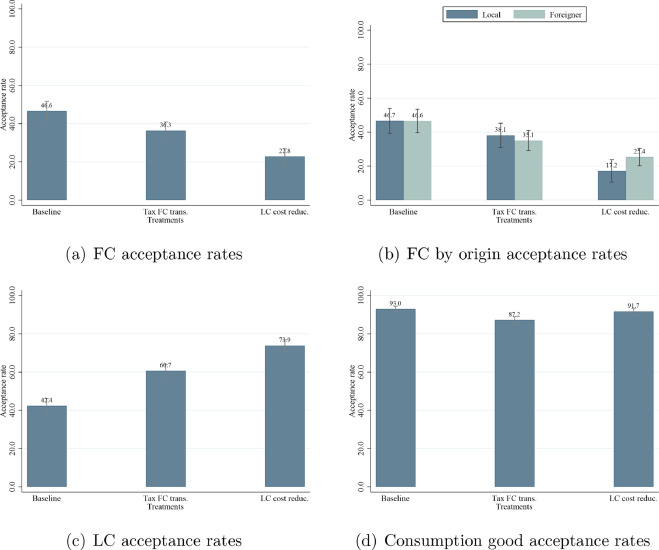
- Policies for Transactional De-Dollarization: A Laboratory Study (with David Florian, Kristian Lopez Vargas, and Valeria Morales)
- Journal of Economic Behavior and Organization, 2022
- Data availability: An anonymized participant-round dataset is available upon request.
-
Abstract
This paper studies taxes on foreign-currency transactions and local-currency incentives, showing that both interventions reduce transactional dollarization, with stronger effects from local-currency incentives.
Policy Analysis
- Modelo de Proyección Trimestral: Una actualización hasta 2019
- Banco Central de Reserva del Perú, Issue 011, 2022
- Proyecciones inmediatas y de corto plazo para la actividad económica en tiempos de la pandemia del COVID-19
- Revista Moneda, Issue 187, 2021